Reading time: 8 minutes
Summary
Tudor is no longer Rolex's "little sister." In 2026, the Black Bay 58 resells for 30 to 50% above its retail price, the Pelagos FXD has become a modern grail, and the Black Bay GMT is breaking liquidity records on the secondary market. With this increase in value comes a reality that few owners anticipate: protecting a Tudor is no longer optional. The titanium of the Pelagos scratches faster than steel, the brushed case of the Black Bay loses its original contrast with the slightest polish, and the secondary depreciation of a poorly preserved Tudor now reaches 15 to 30%. Here is the complete analysis and preservation strategy to adopt in 2026.
Table of Contents
- Tudor in 2026: The Metamorphosis Achieved
- The References That Are Gaining the Most Value
- Why Polishing is Even More Problematic on Tudor
- The Special Case of Pelagos Titanium
- Invisible Physical Protection: The Modern Solution
- The Concrete Calculation: €300 to Preserve €1,500
- Frequently Asked Questions
Introduction
Ten years ago, Tudor was presented as "the affordable alternative to Rolex." In 2026, this description has become obsolete. Tudor has become an autonomous brand, sought after for itself, with a structured secondary market and references that appreciate at a rate few collectors would have imagined.
With this transformation comes a simple business reality: a Tudor that was worth €3,500 in 2020 and is worth €5,200 in 2026 deserves the same preservation attention as a Rolex from the previous decade.
<a id="tudor-2026"></a>
Tudor in 2026: The Metamorphosis Achieved
Three elements explain why Tudor has gone from being a "sub-brand" to a full-fledged horological asset:
1. The difficulty of accessing current production Rolexes
Since 2020, waiting lists for a Submariner, a GMT-Master, or a Daytona in an official boutique have become excessively long (often 3-7 years). This frustration has pushed thousands of collectors to explore Tudor as a credible alternative — not as a compromise, but as a deliberate choice.
2. The increase in technical quality
Since 2015, Tudor has been producing its own COSC-certified movements. The Black Bay equipped with the MT5602 caliber or the Pelagos with the MT5612 technically compete with watches two to three times more expensive. The value for money is, in 2026, the best in the Swiss watch market.
3. A new generation of collectors
Millennial and Gen Z buyers enter watchmaking with a budget of €3,000 to €6,000. Tudor perfectly matches this entry point while offering the cultural depth (Naval heritage, Heritage design, active community) that allows them to "invest" long-term in the brand.
<a id="references-performantes"></a>
The Tudor References That Are Gaining the Most Value in 2026
Here are the average performances observed on the secondary market (Chrono24, WatchCharts):
| Reference | Retail Price | Market Price 2026 (Good Used Condition) | Performance |
|---|---|---|---|
| Black Bay 58 (Steel) | ~€3,600 | ~€4,800 - €5,200 | +35 % |
| Black Bay 58 Blue | ~€3,750 | ~€5,000 - €5,500 | +40 % |
| Black Bay GMT | ~€4,240 | ~€4,800 - €5,400 | +25 % |
| Black Bay Pro | ~€4,080 | ~€4,600 - €5,100 | +22 % |
| Pelagos 42 (Titanium) | ~€4,850 | ~€5,400 - €6,000 | +18 % |
| Pelagos FXD | ~€4,100 | ~€6,500 - €8,000 | +70 % |
| Pelagos 39 | ~€4,450 | ~€5,000 - €5,600 | +18 % |
| Black Bay Bronze | ~€4,200 | ~€4,700 - €5,200 | +15 % |
The Pelagos FXD has become a modern grail in just a few years. Launched in partnership with the French Navy, its limited production and pure functional design have allowed it to gain over 70% in value in just three years.
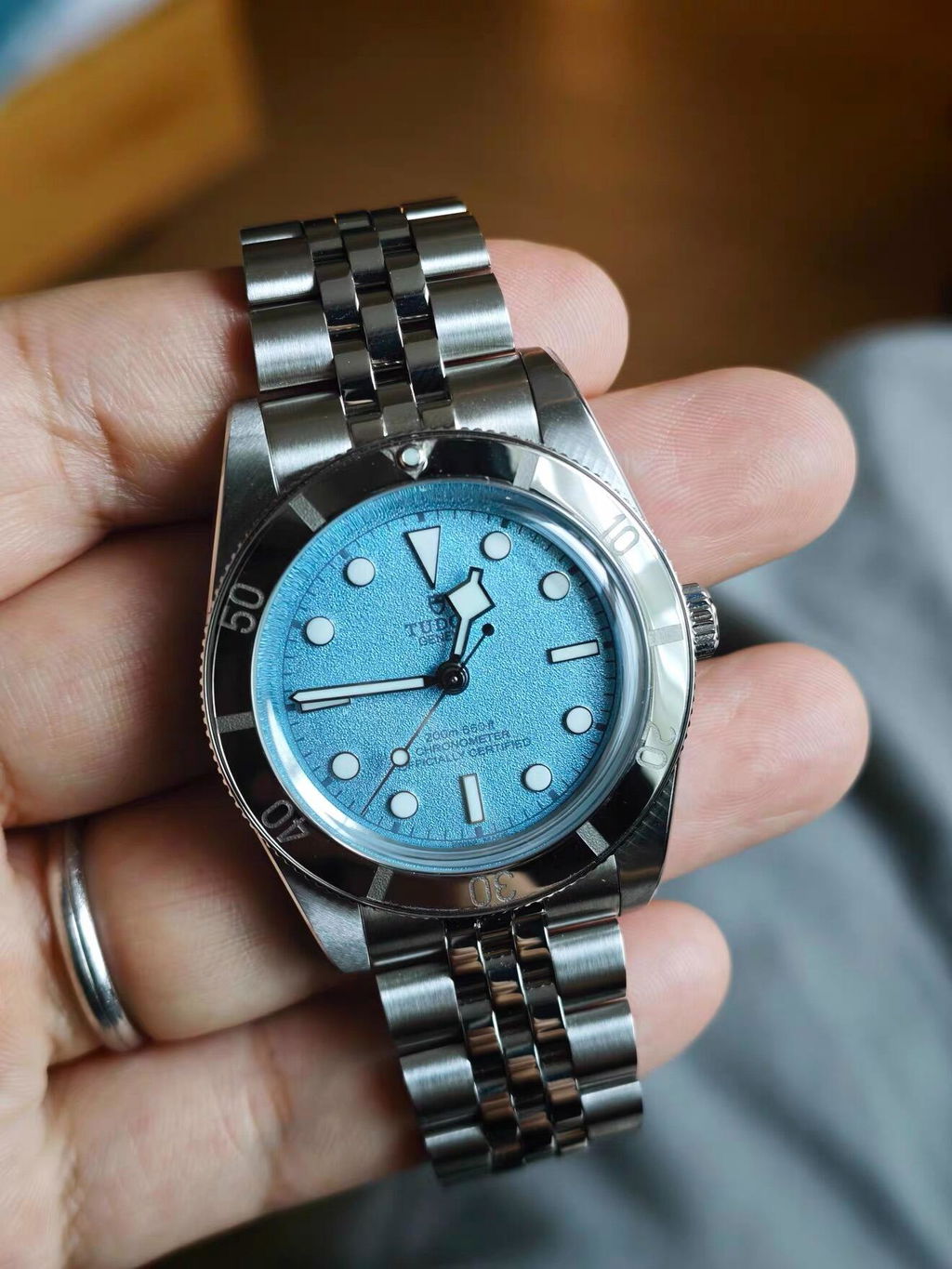
The Black Bay 58 remains the best-performing entry-level piece: its 39mm size, vintage design, and accessible price make it the first Tudor most collectors buy — and they never truly resell it for less than they paid.
<a id="polissage-probleme"></a>
Why Polishing is Even More Problematic on Tudor
The destructive logic of polishing, valid for Rolex, is amplified on Tudor for three specific reasons.
First reason: the polished/brushed contrast is the soul of the design
Both the Black Bay and the Pelagos rely on a very strong contrast between brushed surfaces (case, bracelet) and polished edges (bevels). Traditional polishing flattens this contrast: the brushed surface becomes slightly satin, the polished edge widens. The result immediately looks like an "amateur" watch to a trained eye.
Second reason: Tudor produces in more limited quantities than Rolex
A Black Bay 58 or a Pelagos FXD is not produced in the same volumes as a Submariner. The rarity of an unpolished piece therefore increases faster, which amplifies the premium for original condition.
Third reason: Tudor's clientele is statistically younger and more heritage-educated
The average Tudor collector in 2026 is between 28 and 45 years old, actively follows the secondary market, checks references on Chrono24, and instantly detects a "touched" watch. The depreciation of a poorly preserved Tudor is therefore more immediate than for a Rolex purchased by a less informed buyer.
👉 To understand in depth why polishing destroys value: Audemars Piguet Royal Oak: why scratches cost 3 times more
<a id="titane-pelagos"></a>
The Special Case of Pelagos Titanium
The Pelagos deserves a paragraph of its own. Its grade 2 titanium case has very different technical characteristics from the 904L steel of Rolex or the 316L steel of most Tudors.
Advantages of titanium:
- Lightweight (40% lighter than steel)
- Hypoallergenic
- Resistant to salt corrosion
Critical disadvantage: titanium scratches more easily with light friction.
A scratch that the 316L steel of your Black Bay would withstand without visible trace will immediately become noticeable on the Pelagos' titanium. Simple friction against a desk, a steering wheel, or a belt buckle can be enough.
This is why Tudor workshops themselves strongly advise against polishing the titanium Pelagos. Restoration is technically more complex and the result less predictable than on steel.
For a Pelagos owner, preventive protection is therefore not an aesthetic option — it is an operational necessity.
<a id="protection"></a>
Invisible Physical Protection: The Modern Solution
Faced with a Tudor asset that gains 20 to 70% in value, but wears out faster than its owners realize, only one preventive solution exists in 2026: the application of a precision invisible TPU film.
The principle: a transparent 0.2 mm film, precisely cut for each reference (Black Bay 58, GMT, Pro, Pelagos 42, Pelagos FXD, Pelagos 39), is applied to the case and bracelet. It absorbs micro-scratches instead of the metal, remains invisible to the naked eye, and can be removed without leaving residue.
On Tudor, three critical points make cutting precision essential:
- The polished bevels of the lugs (very fine, noticeable if poorly covered)
- The transition between the bezel and the case
- The central links of the bracelet (the area most exposed to scratches)
A generic film obscures these details and detracts from the aesthetics. A correctly modeled film respects the geometry and remains imperceptible.
This is precisely the work we have done at ChronoSkin Lab for the most sought-after Tudor references in 2026.
What the Film Solves, What It Doesn't Solve
What the film solves:
- Micro-scratches from daily wear (door frames, steering wheel, sleeve)
- Titanium scratches on Pelagos (critical point)
- Prolonged contact with chlorinated or salt water
- Bracelet rubbing against shirts and desks
- Showcase trial marks if you are a dealer
What the film doesn't solve:
- Violent shocks that deform the case
- Scratches already present (the film masks but doesn't repair)
- Mechanical defects of the movement
- Internal oxidation due to a sealing defect
<a id="calcul"></a>
The concrete calculation: €300 to preserve €1,500
Let's take a numerical example of a Black Bay 58 purchased for €3,600 retail in 2026.
| Scenario | Direct cost | Residual value at 5 years |
|---|---|---|
| Without protection, 1 third-party polish | €0 | €3,800 |
| With ChronoSkin over 5 years | ~€300 | €5,200 |
Difference in preserved value: +€1,400 for an investment of €300 over 5 years. That's a return of more than 4 times the initial outlay.
On a Pelagos FXD, the calculation shows a preserved value of approximately +€2,500 against €300 — a return of over 8x.
On a Tudor, this ratio is less spectacular than on AP or Patek, but it remains the most solid return a owner can achieve.
In conclusion
Tudor in 2026 is no longer a "first Rolex". It is an autonomous brand, with its own icons, its own flourishing secondary market, and its own patrimonial rules.
For an owner of a Black Bay 58, a Pelagos or a GMT, the question is no longer whether the brand deserves the same preservation rigor as more prestigious pieces. The answer is yes — and even more so for the Pelagos' titanium.
The good news: with a protection budget between €250 and €400 over five years, you preserve an added value that can reach several thousand euros upon resale.
👉 Discover ChronoSkin protection films for Tudor Black Bay and Pelagos on chronoskinlab.com.
<a id="faq"></a>
Frequently asked questions
Is Tudor a good investment in 2026?
Tudor has become a true asset class since 2024-2025. The Black Bay 58, sold for €3,600 in stores, now trades between €4,800 and €5,500 secondhand in the secondary market. The Pelagos FXD and some limited editions have capital gains exceeding 50%. It's no longer a budget compromise to Rolex: it's an investment in its own right.
Which Tudors appreciate the most in value?
In 2026, the best performing Tudors in the secondary market are: the Black Bay 58 (all versions, first collector's purchase), the Pelagos FXD (Marine Nationale military edition), the Black Bay GMT (very liquid pre-owned), the Black Bay Pro (alternative GMT profile), and certain Heritage Chrono or limited Bronze/Bronze One editions. The Pelagos 39 is also starting to appreciate.
Should a Tudor Black Bay be polished?
No, for the same reasons as a Rolex. The brushed case of the Black Bay 58 and the grade 2 titanium of the Pelagos are particularly sensitive to polishing, which irreversibly removes material and flattens the characteristic polished/brushed contrast. On titanium Pelagos, classic polishing is even strongly discouraged by Tudor workshops themselves. The secondary depreciation for a polished Tudor is estimated between 15% and 30% depending on the reference.
How to protect a Tudor from scratches without hiding it?
The only preventive alternative in 2026 is the application of a precision TPU film (ChronoSkin type) on the case and bracelet. The 0.2 mm film is cut to the micron for each Tudor reference (Black Bay 58, Pelagos, GMT, Pro). It absorbs micro-scratches instead of the metal, remains invisible to the naked eye, and removes without leaving any residue. Particularly relevant on the Pelagos' titanium which scratches easily.
Why has Tudor become so sought after in 2026?
Three cumulative reasons: the difficulty of accessing current production Rolexes (impossible waiting lists), Tudor's rise in technical quality since 2018 (manufacture movements, COSC), and the arrival of a new generation of Millennial/Gen Z collectors with a €3-6K budget who see Tudor as an accessible but serious asset. The brand has tripled its cultural visibility in 5 years.
Is the Tudor Pelagos' titanium more fragile than steel?
The grade 2 titanium of the Pelagos is lighter and more corrosion resistant than steel, but it scratches more easily from light friction. A desk scratch that would slide off steel will leave a more visible mark on titanium. This is why Pelagos owners are particularly careful about physical protection.
Is the ChronoSkin film visible on a Tudor?
No, provided the film is cut to the micron for the exact reference. A 0.2 mm film correctly modeled remains invisible to the naked eye, even in grazing light, and respects the polished chamfers and the bezel/case transition. On titanium as on steel, invisibility is guaranteed when the modeling is precise.
What is the lifespan of a ChronoSkin protection on a Tudor?
Between 24 and 36 months depending on the intensity of wear. Beyond that, the film can be removed without any residue and replaced. The case underneath remains strictly unpolished.
Also read on the ChronoSkin blog
- Investing in a luxury watch in 2026: the complete guide
- Audemars Piguet Royal Oak: why scratches cost 3 times more on this watch than on a Rolex