The most-worn Rolex is also the most exposed
The Rolex Submariner is, across all references, the best-selling luxury watch in the world. It is also, by far, the most worn daily. This is no accident: its versatility — suit, office, sport, water — has been part of its DNA since 1953.
This success has a downside. A Submariner worn every day endures, in a single year, the equivalent of a decade of wear compared to a watch kept for occasions. And unlike a Daytona or a GMT-Master, which are often preserved, the Submariner is precisely the watch that never comes off.
Hence the question most of its owners eventually ask themselves: how can it be worn daily without being ruined? Here are the technical answers, method by method.
Identifying the risk zones of your Submariner
Before talking protection, you need to pinpoint exactly what gets damaged. On a modern Submariner (reference 124060, 126610LN, 126610LV), four areas account for more than 90% of cosmetic damage.
1. The Oyster folding clasp The most exposed part. It rubs against desks, armrests, keyboards, bag straps. Its upper face is mirror-polished — meaning the slightest micro-scratch is immediately visible.
2. The lugs and their chamfers The two beveled edges running along the case are the most value-sensitive feature. Once rounded by polishing, they do not come back.
3. The central bracelet links Mirror-polished on modern references, they capture every light — and every scratch.
4. The case flanks Vertically brushed on modern Submariners, they resist better than polished surfaces but mark permanently in case of a lateral impact against a door or a car frame.
Method n°1: the habits to change immediately (free)
Some scratches are avoidable simply by adjusting a few habits. This isn't a complete solution, but it's a first filter.
At the office
- Remove your watch when typing extensively on a mechanical keyboard — or shift it higher on your forearm.
- Avoid sharp-edged laminate desks (IKEA and the like); rounded or solid wood edges are less aggressive.
- Beware of brushed-aluminum laptop screens: the MacBook hinge is a classic source of scratches.
In the car
- Never rest the hand wearing the watch on a pebbled-leather steering wheel. The micro-grains of leather carry silica and scratch over the long term.
- Watch out for the driver's door and the handbrake.
In social settings
- Firm handshakes with cufflinks: source n°1 of accidental scratches on the bezel and case back.
- Wristwatch on one wrist + leather or metal bracelet on the other: crossing arms produces metal-on-metal contact.
These habits help reduce the most avoidable incidents. They do not solve the diffuse desk diving, which remains unavoidable.
Method n°2: rotation between two watches
Many informed collectors wear their Submariner only on weekends or for occasions, and keep a "work watch" for daily use. Popular options in this logic:
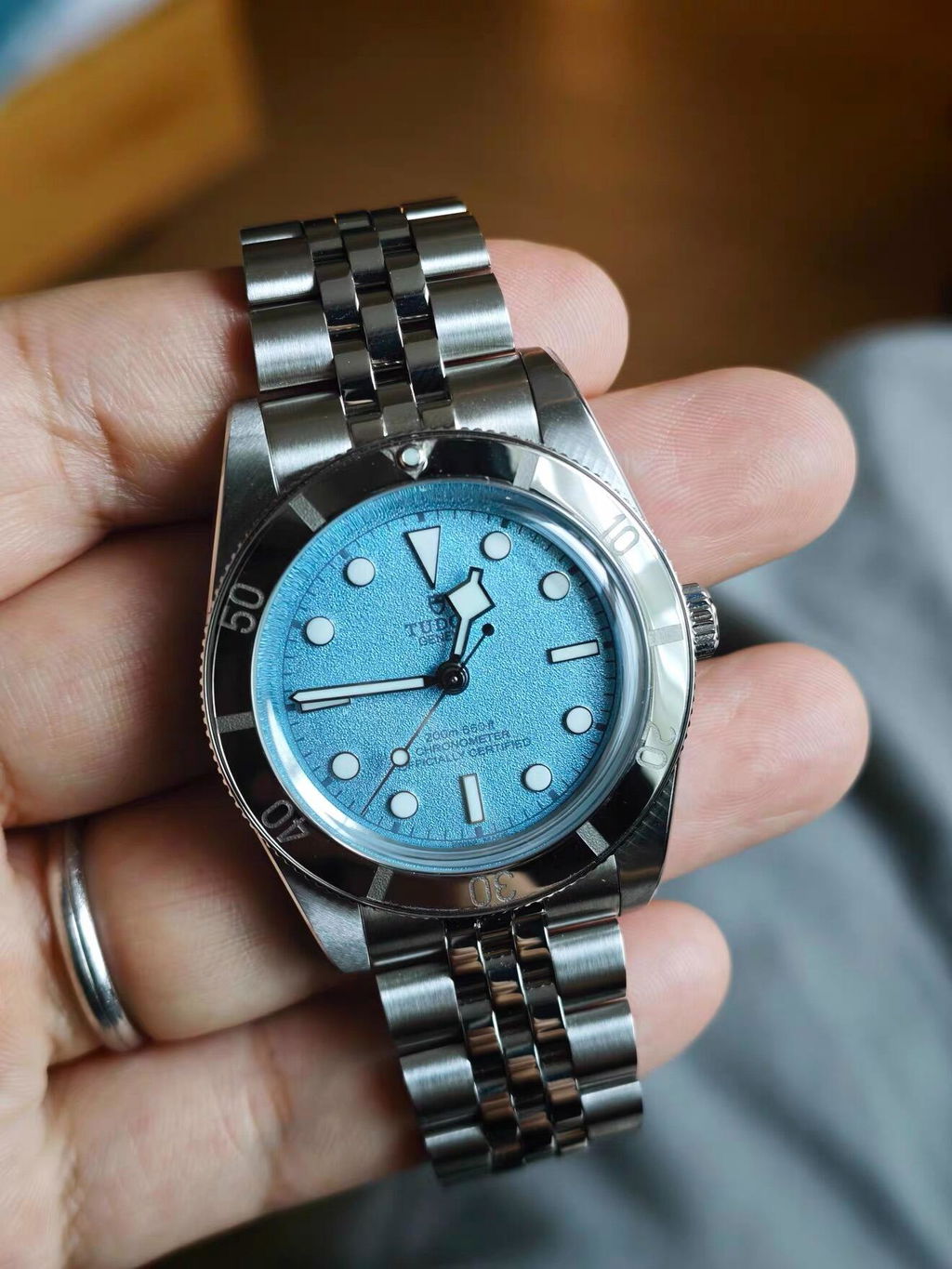
- Tudor Black Bay 58 — the direct heir, €3,500 to €4,500
- Longines Legend Diver — €2,200 to €3,000
- Omega Seamaster 300 — €5,000 to €7,000
The logic is sound, but the economic calculation is less so. You invest €3,000 to €7,000 in a second watch to preserve the wear of the first. Except in specific cases (passion for doubling up, pleasure of rotation), it is a rarely amortized cost.
This strategy suits those who already wanted a second watch. Not those who simply want to protect their Submariner.
Method n°3: the official Rolex service
Rolex Service comes around every 10 years on average and includes a complete mechanical overhaul plus, often, a polishing.
Upsides: your watch returns with certified water-resistance and, short-term, a beautiful appearance. Downsides: the included polishing, as detailed in our dedicated article [Rolex Polishing: Why It Can Cost Your Watch 30% of Its Value], reduces your market value if your example was trading as unpolished.
Our recommendation: explicitly request a service without polishing (service only, no polish). Rolex accepts this request at drop-off. Your watch returns functionally new, cosmetically identical to how it went in.
Method n°4: the micrometric protection film
This is the most recent method — and probably the most rational economically for anyone wearing their Submariner daily without wanting to change habits or buy a second watch.
The principle is simple: an adhesive transparent film, less than 200 microns thick, is laser-cut to the exact shape of each sensitive area of the watch — clasp, lugs, central links. Applied in about ten minutes, it is strictly invisible to the naked eye once in place.
Technical benefits:
- The film absorbs micro-scratches in place of the metal. The surface underneath remains intact.
- Treated against UV, the film does not yellow over time.
- It comes off without residue, at any time — notably before resale.
- It resists water, sweat, and thermal variation.
On a Submariner, complete protection costs between €79 and €99. Compared to the €2,000 to €4,000 of depreciation that a polished Submariner suffers at resale (2026 market figures), the financial equation solves itself.
This is the principle that made PPF a success in collector car circles; this is exactly what ChronoSkin applies to luxury watchmaking.
Method n°5: selective storage
An extreme but sometimes appropriate solution: keep the Submariner exclusively in a safe, taking it out only for occasions. This is the choice of many pure investors, who consider the watch only as a financial asset.
Major drawback: a mechanical watch that never runs eventually creates problems with lubricants. A periodic winding (ideally monthly) remains necessary. And above all, this is precisely the choice of renunciation: a watch that isn't worn no longer fulfills its function.
The recommended action plan
For an owner wearing the Submariner 5 to 7 days a week, the most effective combination is as follows:
- Apply a protection film to sensitive areas from purchase (or today if the watch is recent and lightly marked).
- Modify a few at-risk habits of daily life (keyboard, steering wheel, handshakes).
- At the next Rolex service, explicitly request "no polish".
- At eventual resale, remove the film: the watch is presented unpolished, with its original factory finish intact.
Total cost over 10 years: around €100. Estimated gain at resale: between €2,000 and €5,000 depending on the reference.
The takeaway
A Rolex Submariner is not meant to sleep in a safe. It is meant to be worn — that was Hans Wilsdorf's vision, and that is what gave it its status. But wearing it without precaution, today, means letting several thousand euros of value slip away for a few seconds of inattention per day.
The good news: the best practices cost little, and they compound. By combining them intelligently, you get a Submariner that lives fully, that no longer fears anything — and that, the day it changes wrists, has kept its original word.
See ChronoSkin protections for Rolex Submariner → https://chronoskinlab.com/collections/rolex
The ChronoSkin team — Laboratory of watchmaking precision, France.